Skip to content

The best coffee grinders under 200

Under 200 you choose between a hand grinder that grinds better and an electric one that grinds while you do something else. Both answers are correct; they answer different questions.

Two hundred is the price at which a grinder stops being the reason your coffee is bad. Below it, the usual failure is not burr quality but adjustment: espresso needs a narrow band of fineness, and cheap grinders often offer two or three usable steps inside that band, so one click gushes and the next chokes.

Both of our picks solve that in different ways, and the choice between them is not really about coffee. It is about how many cups you make in a morning, and whether you would rather spend forty seconds of effort or a hundred and twenty euros.

Which one do you need?

You brew filter
This budget is plenty: a good grinder in this bracket does honest work at medium and coarse settings.
You make espresso
This is the difficult zone. Look first for adjustment that is fine and nuanced enough; many grinders at this price stop too coarse.
You are willing to grind by hand
At this budget a hand grinder offers burr quality no electric matches. The trade is effort, not result.
You grind for several cups
Electric is the answer: grinding sixty grams by hand every morning is not a sustainable choice.

Choosing by use

Morning filter

The use where this budget is most comfortable. The gap to a grinder three times the price is audible but not decisive.

Daily espresso

The budget starts to bite: expect coarser adjustment and more retention, or move to a hand grinder.

Two methods in rotation

Possible, but a lot to ask at this price. The grinder will be the weak link, and it is better to know that going in.

Starting out with no plan

A versatile grinder at this budget carries the first months well, and resells decently if you move up.

The criteria that actually matter

Burrs, not blades
The one non-negotiable line at this budget. A blade grinder costs less and sizes nothing: it makes a mixture of dust and chips that no method rescues.
How fine it will actually go
Many grinders at this price claim espresso without truly reaching it. The thing to check is the finest setting, not the number of settings.
Dose consistency
A grinder that does not deliver the same amount twice forces you to weigh every dose. Not a disaster, but worth knowing.
Noise and vibration
Grinders in this bracket are loud, and some walk across the worktop. That is the kind of flaw you discover after buying.

Which criterion for which use

What you brewWhat this budget buysWhat it does not
Filter, pressA genuinely honest resultFinish and quiet
EspressoAn adjustable compromiseTruly fine adjustment
BothAn acknowledged weak linkExcellence at either end
One dose a dayA hand grinder, very well placedSpeed

Mistakes to avoid

Buying blades because they are cheaper
The price gap is real and so is the result gap. A blade grinder with a good machine makes worse coffee than a burr grinder with a modest one.
Trusting the word "espresso" on the box
It is printed without commitment. What counts is whether the finest setting genuinely slows the shot, and that shows up in use.
Neglecting cleaning from the start
Grinders in this bracket often have an awkward chamber. Deposit settles fast and gives a rancid taste that gets blamed on the coffee.
Buying used without seeing the burrs
Worn burrs do not show in a photograph and cannot always be replaced at this level. They are the one genuine wear part.

Choosing by profile

The filter drinker
An electric burr grinder with a mid range, without worrying about the finest setting. This is where the budget goes furthest.
The espresso beginner
A good hand grinder, or an electric you have checked goes fine enough. The compromise is chosen knowingly.
The household
An electric that handles a large dose, even at the cost of fineness: volume is what decides here.

Upkeep and how long it lasts

At this level maintenance matters more than elsewhere: tolerances are wider and deposit tells sooner. Regular brushing beats one thorough clean a year.

  • Brush the chute and chamber dry, with no water and no detergent.
  • Purge after every change of setting or of coffee.
  • Check nothing has lodged between the burrs before forcing the adjustment.
  • Stand the grinder on a non-slip mat: it works better when it does not move.
  1. Best first espresso grinder Grinders

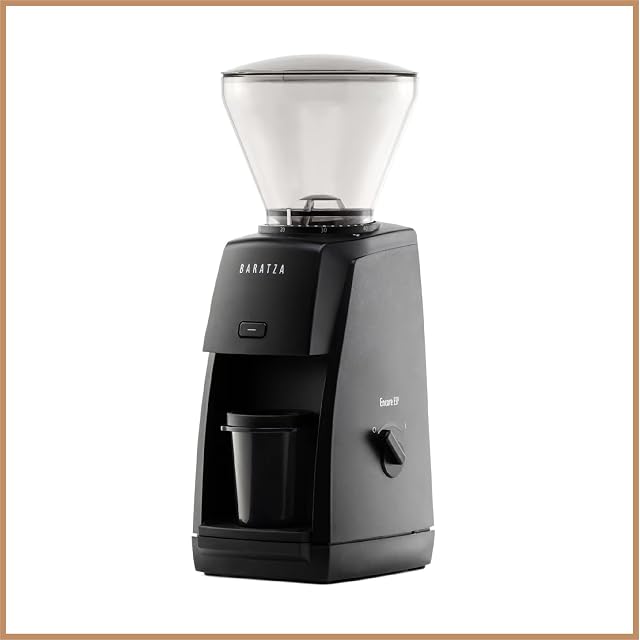
    Baratza Encore ESP

    40 mm conical · 40 espresso steps + 20 filter

    The cheapest electric grinder that genuinely does espresso and filter without being bad at both. Forty fine steps in the espresso range is the whole point — and Baratza will still sell you a burr set for it in ten years.

    Best for: Anyone pairing a grinder with a Gaggia Classic, a Dedica upgrade, or a Barista Express they have outgrown.

    8.7/10

    ≈ $200 / £190 / 220 €

  2. Best value grinder, full stop Grinders

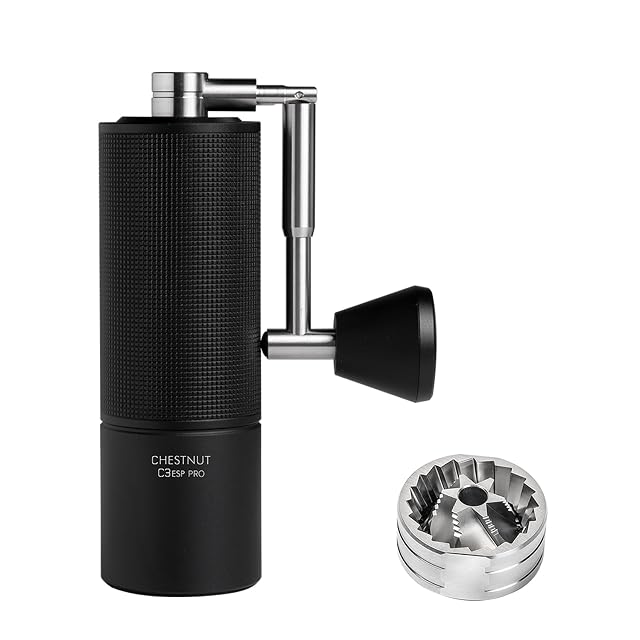
    TIMEMORE Chestnut C3 ESP Pro

    38 mm stainless burr · hand · espresso-capable

    Out-grinds electric grinders costing three times as much, provided you accept the arm. The ESP burr reaches espresso fineness with real adjustment — which is not true of most hand grinders at any price.

    Best for: One or two coffees a day, or a travel grinder that does not compromise.

    8.4/10

    ≈ $80 / £70 / 75 €

Questions people actually ask

Hand or electric at this price?

A hand grinder at 80 out-grinds an electric grinder at 200 on pure consistency, because none of its budget went to a motor. It also costs you 40 seconds of cranking per espresso dose. If you make one or two coffees a day, buy the hand grinder; if you make four before work, buy the electric one.

Why does my cheap grinder make bad espresso?

Almost always adjustment range rather than burr quality. Espresso lives in a narrow band of fineness, and cheap grinders often have only two or three usable steps inside it — so one click is too coarse and the next chokes the machine. A grinder with fine steps in the espresso range is what fixes it.

Is it worth upgrading the grinder before the machine?

Yes, nearly always. Grind consistency determines whether a shot is repeatable at all; the machine determines how good a repeatable shot can be. A 400 machine with a 400 grinder beats a 700 machine with a 100 grinder, reliably.

Is the grinder in a bean-to-cup enough?

It is built for consistency, not for fine adjustment. For portafilter espresso, even a modest dedicated grinder gives more room to work.

Should I buy used at this budget?

Often a good calculation, provided you see the burrs. They are the only real wear part, and they cannot always be replaced at this level.

Can a grinder at this price last?

Nothing supports quoting a lifespan: it depends on kilos ground, roast level and cleaning. What is known is that oil deposit does more damage than use itself.

How many grind steps do I need?

The number matters less than where they fall. For espresso, what counts is being able to sit between two useful steps; for filter, having nuance at coarse settings.

Can an entry-level grinder be improved?

Regular cleaning and a non-slip mat genuinely change the result. Beyond that, parts are generally not available at this level.

Why each one, and for whom

Baratza Encore ESP · $200

For : Anyone pairing a grinder with a Gaggia Classic, a Dedica upgrade, or a Barista Express they have outgrown.

Main strength : 40 closely-spaced steps in the espresso range — you can actually dial a shot

Main limitation : Retention of roughly a gram means single-dosing needs a bellows or a tap

Read the full review →

TIMEMORE Chestnut C3 ESP Pro · $80

For : One or two coffees a day, or a travel grinder that does not compromise.

Main strength : Grind quality genuinely competes with 200-euro electric grinders

Main limitation : About 40 seconds of steady cranking per espresso dose

Read the full review →

What each price bracket buys

Entry level

$80 – $110

2 models

Mid range

$200 – $340

2 models

Upper range

$345 – $450

2 models

Deciding in one line

Useful comparisons

Head-to-heads already published between two models from this guide or this aisle.

How this guide is built

The models here come from the catalogue of this site. Specifications are those published by the manufacturer and on the Amazon product page; prices are what Keepa reported on the date below, and both move. The ranking uses declared specifications, the balance of stated strengths and limitations, and price. No product on this site has been physically tested, and nothing here claims otherwise.

Last checked on

The tool we use ourselves

Chosen your machine? Now buy it at the right price.

Espresso machines and grinders swing by a hundred euros or more across the year, and the biggest "discounts" often land at prices the same model sold for six weeks earlier. UniverTrack tracks the real price history across retailers, spots fake reductions, and alerts you when it is genuinely the moment to buy.

Real price historyBuy-now alertsAI buying assistant
Try free for 14 days →
No commitment · Cancel in one click · 5 languages