Skip to content

The best coffee scales for espresso and pour-over

Two scales, two jobs. Espresso needs speed and 0.1 g; pour-over needs a timer that starts itself and a shape that fits a dripper.

The scale is the least interesting purchase in coffee and one of the most consequential, because everything else you do is an attempt to be repeatable and you cannot repeat what you did not measure.

Three specifications separate a coffee scale from a kitchen scale: resolution, refresh speed and footprint. Which of them matters depends entirely on whether you are standing over a portafilter or a dripper, which is why the two picks below are not really competing.

Which one do you need?

You make espresso
Refresh rate comes first: a slow scale gives you out-of-date information at the very moment the shot ends.
You brew pour-over
A built-in timer and a platform wide enough for a carafe serve you better than resolution does.
You mostly weigh beans
An ordinary kitchen scale is enough; the specialised features only serve brewing.
You are serious about progressing
Take one that resists moisture: that is what kills them, long before the electronics fail.

Choosing by use

Weighing the dose

The minimum and most useful use: without a weighed dose, no setting is repeatable from one day to the next.

Following the brew live

Weighing the drink as it runs tells you when to stop. That is where refresh rate counts.

Timing

Weight and time together describe an extraction. A built-in timer saves juggling a phone with wet hands.

Weighing the pour

In pour-over, pouring by weight rather than by eye removes one source of variation between brews.

The criteria that actually matter

Refresh rate
A scale that takes a second to settle is unusable for espresso, where the shot lasts about thirty. It is the most important criterion and the least often quoted.
Resolution
A tenth of a gram is comfortable for the dose and becomes pointless for the drink. Finer resolution is not a guarantee of accuracy.
Moisture resistance
A coffee scale lives under a machine that drips. It is almost always water that kills it, not wear. A removable platform and a seal transform its life.
Platform size
It has to take a cup, a portafilter or a carafe depending on use. Too small a platform forces balancing acts that end badly.

Which criterion for which use

Your methodWhat countsWhat does not
EspressoRefresh rateVery fine resolution
Pour-overTimer, large platformExtreme speed
Weighing beansNothing specialDedicated features
Daily useSealingStyling

Mistakes to avoid

Putting the scale under a dripping machine
That is the number-one cause of death. A small tray above it, or simply a cloth, extends its life more than any other precaution.
Trusting the tare after a knock
A scale that has taken a loaded portafilter can drift. An occasional check against a known weight stops you dialling in on a false reading.
Measuring by volume rather than weight
A spoon of coffee changes mass with roast and grind. That is precisely what a scale exists to remove.
Choosing on resolution alone
A hundredth of a gram displayed by a slow, unstable scale is worth nothing. Stability beats decimal places.

Choosing by profile

Espresso
Fast, sealed, a platform that fits a portafilter. The rest is incidental.
Pour-over
Built-in timer, wide platform, decent battery life. Extreme precision adds nothing here.
The household
A sturdy kitchen scale is enough for weighing beans; a specialised one only makes sense with a method you follow.

Upkeep and how long it lasts

A coffee scale does not wear out, it drowns. Moisture gets in through the keys and the battery compartment, and corrosion does the rest. No lifespan can be quoted: it depends almost entirely on exposure to water.

  • Wipe any splash immediately, including under the platform.
  • Take the batteries out during long periods of disuse.
  • Never run the scale under a tap, even if the platform lifts off.
  • Check the tare against a known weight from time to time.
  1. Best scale under 100 Scales

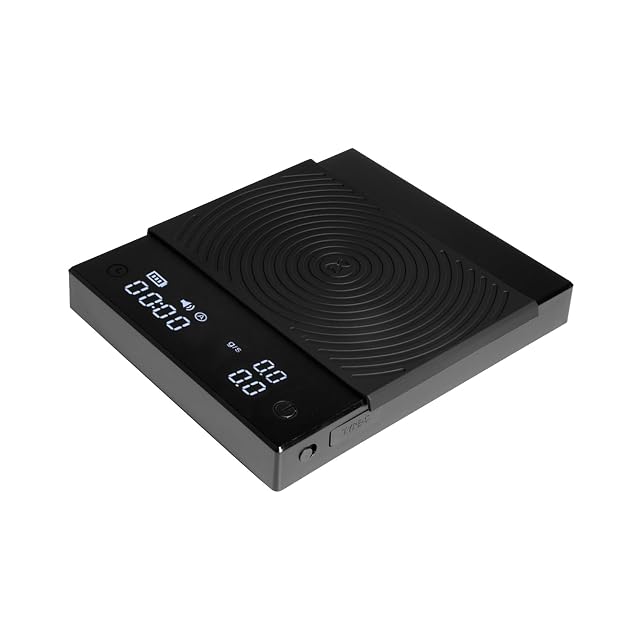
    TIMEMORE Black Mirror Basic 2

    2 kg × 0.1 g · flow rate · under-portafilter footprint

    Fast enough for espresso, small enough for a drip tray, and it shows flow rate — which is the one number that tells you what your shot is doing while it is still happening.

    Best for: Espresso, where 0.1 g and a fast refresh genuinely change what you can control.

    8.5/10

    ≈ $60 / £50 / 55 €

  2. Best for pour-over Scales

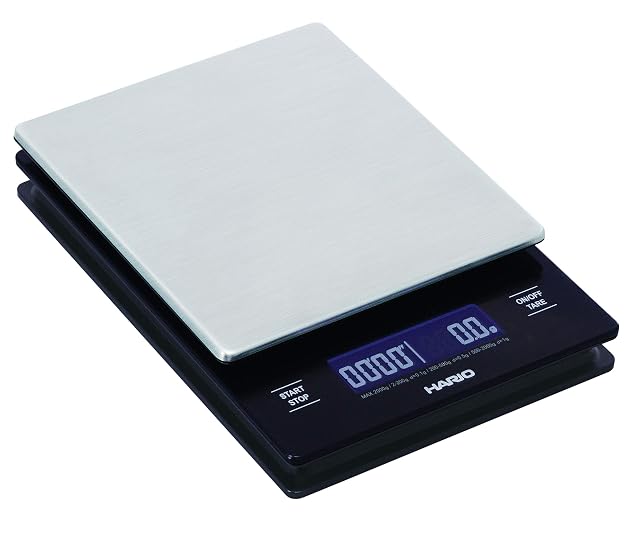
    Hario V60 Drip Scale

    2 kg × 0.1 g · auto timer · V60 footprint

    Built around the V60 rather than adapted to it: the footprint fits a dripper and a carafe, and the timer starts on its own when the first drops land.

    Best for: Pour-over and immersion brewing, where a timer matters more than refresh speed.

    7.9/10

    ≈ $60 / £50 / 55 €

Questions people actually ask

Do I need 0.1 g resolution?

For espresso, yes — an 18 g dose and a 36 g yield mean a gram is over 5 per cent of the target. For filter, 1 g is plenty, because you are weighing 15 g of coffee into 250 g of water and a gram is noise.

Why does refresh speed matter?

Because a slow scale shows you what happened half a second ago, so you stop the shot late and overshoot your target yield every time. Under a portafilter, a fast refresh is worth more than another decimal place.

Why do coffee scales die so often?

Water. They sit on drip trays and next to kettles and almost none of them are sealed. A silicone mat underneath and a wiped tray roughly doubles the life of any scale in this price range.

Is a kitchen scale enough?

For weighing beans, yes. For following a brew, no: the display lag and the resolution make it unusable while the coffee is running.

Weigh the drink, or only the coffee?

Weighing both gives you a ratio, and it is the ratio that repeats from day to day. Weighing the dose alone is already a large step forward.

Why do the readings keep moving?

Machine vibration, an unstable platform, or moisture. A scale on a firm surface and away from splashes settles far better.

Are built-in timers useful?

For pour-over, yes: time and weight read in one place, with no phone to touch with wet hands. On espresso it is one more convenience.

How do I check a scale is still accurate?

By putting a known weight on it now and then. A coin of standard mass makes a good enough reference to spot drift.

Why each one, and for whom

TIMEMORE Black Mirror Basic 2 · $60

For : Espresso, where 0.1 g and a fast refresh genuinely change what you can control.

Main strength : 0.1 g resolution with a genuinely fast refresh — usable live under a portafilter

Main limitation : Not waterproof — a drip tray is a wet place and this is a known weak point

Read the full review →

Hario V60 Drip Scale · $60

For : Pour-over and immersion brewing, where a timer matters more than refresh speed.

Main strength : Auto-start timer triggered by the first drops — one less thing to do mid-brew

Main limitation : Slower refresh than espresso-focused scales; you can overshoot

Read the full review →

Deciding in one line

How this guide is built

The models here come from the catalogue of this site. Specifications are those published by the manufacturer and on the Amazon product page; prices are what Keepa reported on the date below, and both move. The ranking uses declared specifications, the balance of stated strengths and limitations, and price. No product on this site has been physically tested, and nothing here claims otherwise.

Last checked on

The tool we use ourselves

Chosen your machine? Now buy it at the right price.

Espresso machines and grinders swing by a hundred euros or more across the year, and the biggest "discounts" often land at prices the same model sold for six weeks earlier. UniverTrack tracks the real price history across retailers, spots fake reductions, and alerts you when it is genuinely the moment to buy.

Real price historyBuy-now alertsAI buying assistant
Try free for 14 days →
No commitment · Cancel in one click · 5 languages