Skip to content

The best gooseneck kettles for pour-over

Ranked on flow control rather than temperature accuracy, because the spout is what changes your brews and the thermometer is what sells the kettle.

A gooseneck kettle is not a refinement for pour-over; it is the control surface. A normal kettle has a wide spout designed to fill a mug quickly, so it delivers water in surges that punch through the coffee bed and open a channel for the rest of the water to escape through.

That means the spout is what you are buying. Temperature displays get the attention, and between them and the hold function, only the hold function changes brews. These three are ranked on how controllable each is at the slow flow rates a bloom actually needs.

Which one do you need?

You brew pour-over regularly
A kettle with variable temperature: every roast wants different water, and boiling suits almost none of them.
You also drink tea
Variable temperature earns its keep further still: green and white teas are ruined by boiling water.
You mainly want pour control
The spout and the balance matter more than the electronics. A well-balanced kettle with no settings pours better than a feature-laden one.
You travel
A stovetop kettle with no electronics: it survives foreign sockets and different voltages.

Choosing by use

V60 and controlled pours

The fine, steady stream is the whole point of a gooseneck: it lets you wet the bed without digging into it.

Chemex and larger volumes

Enough capacity avoids refilling mid-brew, which breaks the rhythm and drops the temperature.

Tea

Temperature control serves tea even more than coffee, and often justifies the purchase on its own.

Hold-at-temperature

Useful when brewing several cups or taking your time; pointless for one quick cup, and it uses power.

The criteria that actually matter

The spout and the flow
This is what the object exists for. Too wide a spout will not give a fine stream; a badly shaped one drips when you stop, which grates every day.
Variable temperature
Essential only if you change coffee or drink tea. Otherwise letting boiled water rest a minute gets close to the same result.
Balance in the hand
A counterbalanced handle keeps the wrist steady as the kettle empties. That is what makes a slow pour repeatable.
The inside material
Stainless is neutral; plastic interiors can mark the water at first. The detail counts with light roasts, where everything shows.

Which criterion for which use

What you brewWhat mattersWhat is secondary
Filter coffee, regularlySpout and balanceHold-at-temperature
Varied coffeesVariable temperatureCapacity
TeaVariable temperatureA very fine stream
TravelRobust, no electronicsFeatures

Mistakes to avoid

Pouring at boiling point
Almost no coffee method wants a hundred degrees. Boiling water scorches delicate aromas and sharpens bitterness.
Filling to the brim
A full kettle is heavy and hard to pour slowly, and the gooseneck loses its point. Fill what you need.
Judging the flow with cold water
In a shop the test is cold; hot, steam and expansion change the behaviour a little. The real verdict comes from use.
Leaving water in it
Standing water scales faster and picks up a taste. Empty after use, especially with hard water.

Choosing by profile

The pour-over enthusiast
Fine spout, balanced handle, variable temperature. It is the tool that makes the pour repeatable.
The tea-and-coffee household
Temperature control earns its keep twice a day and justifies the price gap on its own.
The minimalist
A well-balanced stovetop kettle: no electronics to fail, and control stays in the hand.

Upkeep and how long it lasts

Kettles scale, and scale changes both heating speed and taste. The narrow neck cleans badly, which makes regular descaling more important than on an ordinary kettle.

  • Descale to suit your water, without waiting for visible deposits.
  • Empty after use rather than letting water cool inside.
  • Rinse thoroughly after descaling: the neck holds product.
  • On base-plate models, keep the contacts dry and clean.

Safety

The risk is ordinary but real: water near boiling, poured slowly, often close to the body.

  • Do not fill past the maximum mark: water spits from the spout as it boils.
  • Pour with your hand clear of the steam plume, which burns faster than water.
  • Keep the base away from the worktop edge and from the cable.
  • Do not lift the lid while it heats.
  1. Best pour control Kettles

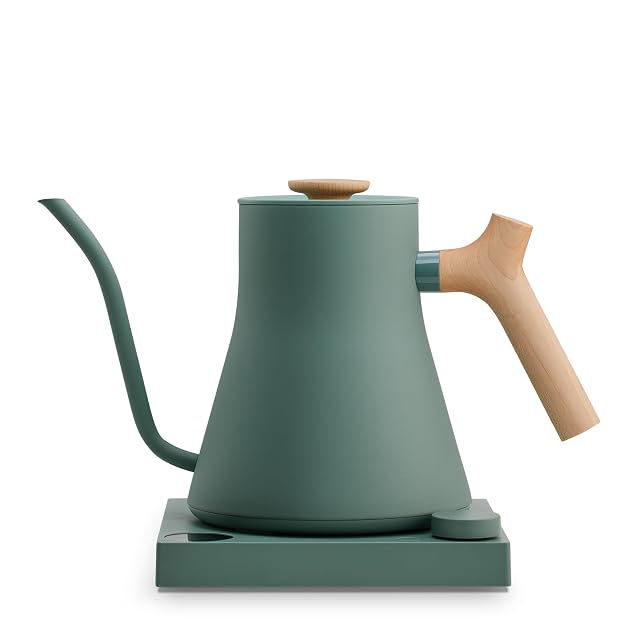
    Fellow Stagg EKG Pro

    0.9 L · ±1 °C hold · counterbalanced gooseneck

    The best-pouring kettle sold, and the hold function matters more than the thermometer. Expensive for boiling water — but if you brew pour-over daily, it is the accessory that most improves the cup.

    Best for: Daily pour-over, where flow rate is the variable you are trying to control.

    8.6/10

    ≈ $195 / £165 / 180 €

  2. Best value gooseneck Kettles

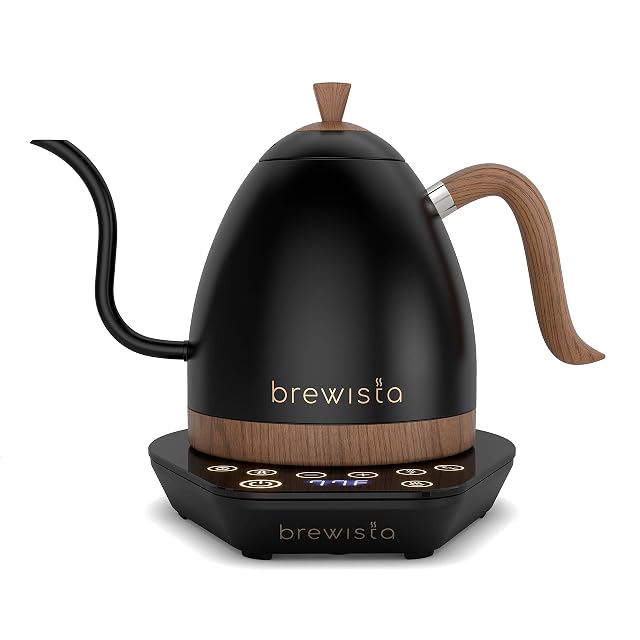
    Brewista Artisan Gooseneck

    1 L · variable temperature · hold · narrow spout

    Almost everything the Fellow Stagg does, for meaningfully less money and with a litre of capacity instead of 900 ml. It is less beautiful, and that is genuinely the main difference.

    Best for: Daily pour-over where the money is better spent on the grinder.

    8.3/10

    ≈ $130 / £110 / 120 €

  3. Cheapest usable gooseneck Kettles

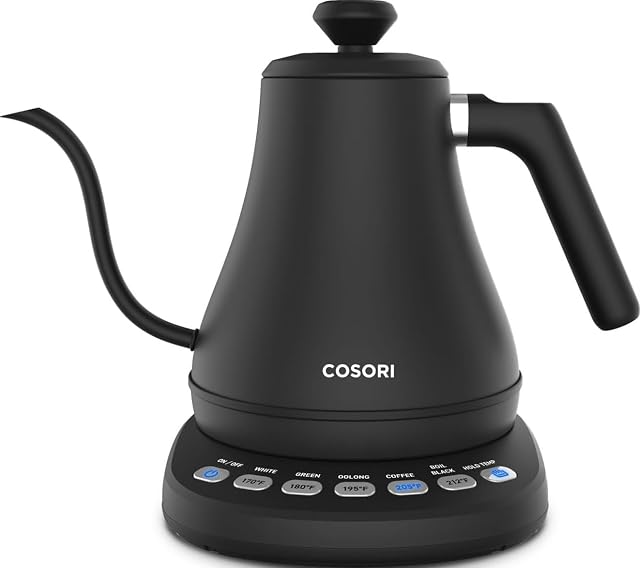
    COSORI Gooseneck Electric Kettle

    0.8 L · 5 presets · keep-warm

    A gooseneck spout and variable temperature for well under half the price of the specialists. The pour is good rather than excellent, and for most people learning pour-over that is enough.

    Best for: A first gooseneck, to find out whether pour-over is a habit or a phase.

    7.5/10

    ≈ $70

Questions people actually ask

Do I need variable temperature?

Less than the marketing suggests. Brewing at 92 rather than 96 C is a real but small difference, far smaller than one grind adjustment. What genuinely helps is a hold function that keeps the kettle at your target while you grind, rinse the filter and weigh the dose.

Is an expensive gooseneck worth it over a cheap one?

The first step — from a normal kettle to any gooseneck — is by far the largest. Going from a 70 gooseneck to a 180 one buys better control at very slow flow rates and a nicer object. If a grinder is still on the shopping list, buy the cheap gooseneck.

What does a counterbalanced handle do?

It keeps the kettle level as it empties. A conventional kettle becomes top-heavy and wants to tip forward, which shows up as a wobbling pour exactly when the coffee bed is most vulnerable.

What temperature for which coffee?

The lighter the roast, the hotter the water; the darker it is, the further you come down. The useful range sits below boiling, and is set by taste.

Will an ordinary kettle do?

For immersion, yes. For a controlled pour, the gooseneck genuinely changes the gesture: the fine stream is what stops you digging into the bed.

Does holding temperature spoil the taste?

Water held hot for a long time loses dissolved oxygen and gives a slightly flat cup. For one cup the effect is small; over a morning it shows.

Stainless or glass?

Stainless is tougher and neutral; glass shows the scale and cools faster. The choice is about use, not about what is in the cup.

Why does my kettle drip at the end of a pour?

The shape of the spout. It is a common flaw, invisible in a photograph, discovered in use: the answer is to finish the pour with a decisive movement rather than tailing off.

Why each one, and for whom

Fellow Stagg EKG Pro · $195

For : Daily pour-over, where flow rate is the variable you are trying to control.

Main strength : Best flow control of any kettle — slow pours stay genuinely slow

Main limitation : Very expensive for what it fundamentally is

Read the full review →

Brewista Artisan Gooseneck · $130

For : Daily pour-over where the money is better spent on the grinder.

Main strength : Very good pour control at low flow, close to the Stagg

Main limitation : Build feels a step below the Stagg; the lid is the weak point

Read the full review →

COSORI Gooseneck Electric Kettle · $70

For : A first gooseneck, to find out whether pour-over is a habit or a phase.

Main strength : A genuine gooseneck spout at an entry price

Main limitation : Pour is less controllable than a Stagg or Artisan at very slow rates

Read the full review →

Deciding in one line

Useful comparisons

Head-to-heads already published between two models from this guide or this aisle.

How this guide is built

The models here come from the catalogue of this site. Specifications are those published by the manufacturer and on the Amazon product page; prices are what Keepa reported on the date below, and both move. The ranking uses declared specifications, the balance of stated strengths and limitations, and price. No product on this site has been physically tested, and nothing here claims otherwise.

Last checked on

The tool we use ourselves

Chosen your machine? Now buy it at the right price.

Espresso machines and grinders swing by a hundred euros or more across the year, and the biggest "discounts" often land at prices the same model sold for six weeks earlier. UniverTrack tracks the real price history across retailers, spots fake reductions, and alerts you when it is genuinely the moment to buy.

Real price historyBuy-now alertsAI buying assistant
Try free for 14 days →
No commitment · Cancel in one click · 5 languages