Milk texturing is two distinct actions and almost everyone runs them together. Separating them is the whole technique.
Fill the jug correctly
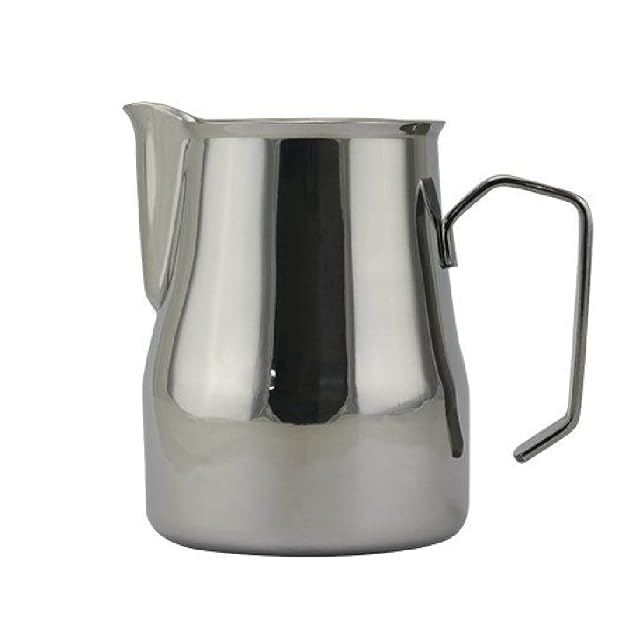
Between one third and one half full. Milk roughly doubles in volume, and it needs room to move — a jug filled to the brim cannot form a vortex, and a jug with 150 ml in a one-liter pitcher cannot either. A 500 ml pitcher is right for 150 to 250 ml of milk, which is one large or two small drinks.
Phase one: stretch
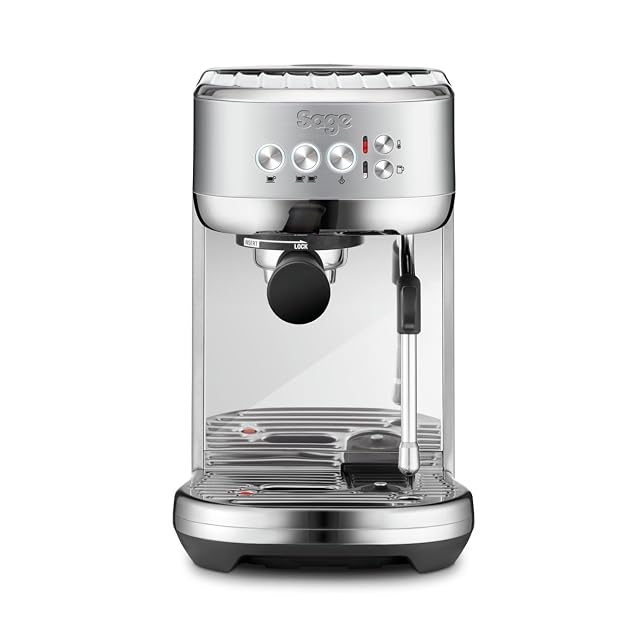
Tip of the wand just below the surface. You want a steady tss-tss — that is air being drawn in. Do this for three to five seconds only. This is where most people go wrong: ten seconds of stretching gives you a jug of bubbles that no amount of spinning will rescue.
The milk should rise perceptibly. That is enough air.
Phase two: spin
Now push the wand deeper and angle it off-center so the milk starts rotating. The noise should disappear into a low rumble. You are no longer adding air — you are breaking the bubbles you already made into progressively smaller ones and folding them through the milk.
Keep spinning until the whole jug moves as one vortex and the surface looks like wet paint: glossy, no visible bubbles, moving like a liquid rather than a foam.
Stop at the right moment
Around 60 to 65 °C (140 to 149 °F). Hand on the side of the jug, stop when you cannot hold it comfortably. Past 70 °C (158 °F) the milk tastes cooked, and no technique recovers it.
Pour immediately
Textured milk separates within about thirty seconds. Wipe the wand, purge it, and pour straight away. If it has started to separate, swirl the jug hard and tap it once on the worktop — that will re-integrate it for a few seconds, which is usually enough.
If your machine has no wand
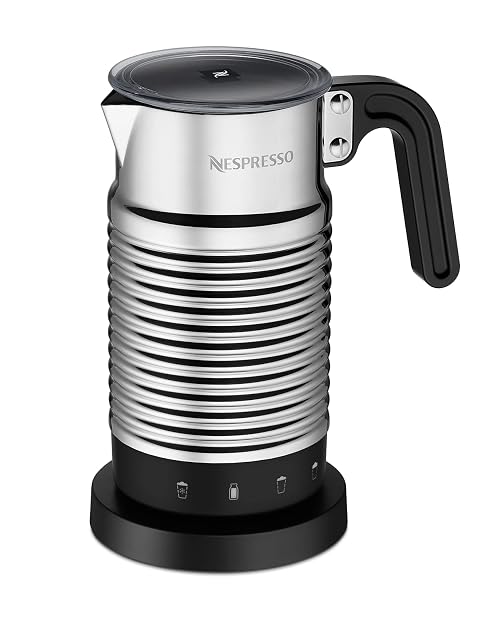
An automatic frother produces dense, correct foam that sits on a drink and will never pour a pattern. That is a limitation of the mechanism, not of your technique — do not spend weeks trying to fix it.
What people want to know
Why does my foam separate before I finish pouring?
The two phases were not integrated. If you stretch too long and spin too little, you get foam sitting on liquid milk rather than one uniform texture. Spin until the whole jug is moving as a single vortex and the surface looks like wet paint.
What temperature should I stop at?
Around 60 to 65 C. Past roughly 70 the lactose starts breaking down and the milk tastes cooked and thin. Judge by hand on the side of the jug — stop when it becomes uncomfortable to hold — or clip a thermometer on until you learn it.
Does oat milk work?
Barista editions do, and standard supermarket oat milk mostly does not. Barista formulations add a small amount of fat and stabilisers precisely so the foam holds. Plant milks also have a narrower temperature window, so stop a few degrees earlier than you would with dairy.
Last reviewed 8 August 2026