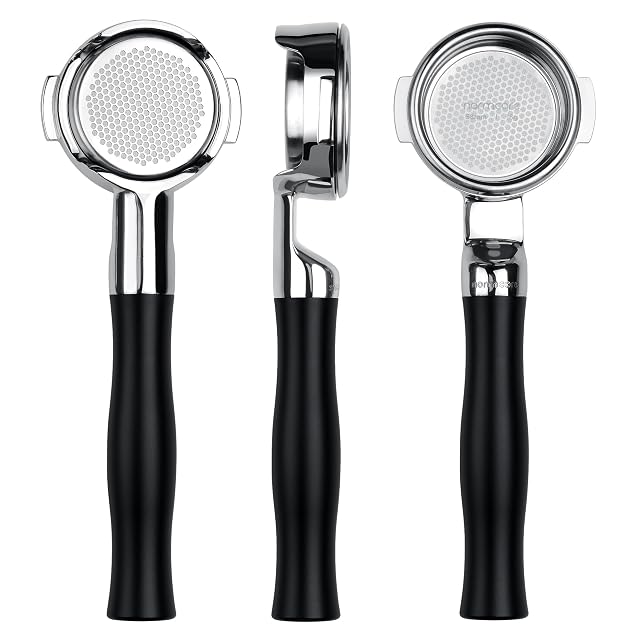
Eight fine needles you stir through the grounds before tamping. It costs twenty euros and fixes more bad shots than any other accessory here — including ones costing twenty times as much.
The bottom line Twenty euros. Buy it before anything else on this site.
If this site recommended one accessory and nothing else, it would be this one, and the reasoning is not about the tool but about the failure it addresses.
Channelling is the single most common cause of bad espresso at home. Water, pushed at nine bars, takes the path of least resistance through the coffee bed — and if part of that bed is denser than the rest, the water goes around it. The result is simultaneously over-extracted where the water ran and under-extracted where it did not, which tastes sour and bitter at once and cannot be fixed by adjusting grind or dose.
The dense parts are clumps, and your grinder makes them. Ground coffee is statically charged and sticky, so it leaves the chute in knots rather than as loose particles. Tamping does not break them up — it compresses them along with everything else.
Eight needles of 0.3 mm stirred through the bed does break them up. The needles are fine enough to pass through without dragging the coffee into new formations, and stirring the full depth rather than just the surface is what matters. Ten seconds, and the bed becomes uniform.
The result on a bottomless portafilter is immediate and visible: instead of one or two jets spraying sideways, the extraction comes down as a single even column. That change costs twenty euros and no learning.
The only people it does nothing for are those using pressurised baskets, where pressure comes from a valve rather than the coffee, and distribution is beside the point.
What we like, and what we don't
Strengths
Fixes channelling at its actual cause — clumps inside the bed
0.3 mm needles are fine enough to pass through without dragging
Magnetic stand keeps it upright and off the worktop
Compromises
Adds fifteen seconds to every shot
Needles bend if you are heavy-handed or drop it
Does nothing at all for pressurised baskets
Where this one sits in its aisle
At 25 $, it is the 1 cheapest of the 5 models in this category published here.
Cheapest in the aisle25 $
Median55 $
Dearest in the aisle70 $
Specifications
Needles
8 × 0.3 mm stainless
Stand
Magnetic base
Suits
51, 54 and 58 mm baskets
Technique
Stir through the full bed depth
Questions people actually ask
What is WDT and why does it work?
Weiss Distribution Technique — named after the person who popularised it. Grinders dispense coffee in clumps, and a clump is denser than the coffee around it, so water goes around rather than through. Stirring the bed with fine needles breaks the clumps and evens out density, so water passes through the whole puck. It removes the cause of channelling rather than compensating for it.
How do I actually use it?
After dosing into the basket, stir gently in small circles through the full depth of the bed — the point is the bottom as much as the top — then level and tamp. Ten to fifteen seconds. Do not stab; the needles bend.
Do I need this if I use a pressurised basket?
No. A pressurised basket builds pressure at a valve rather than through the coffee, so distribution barely affects the result. If you are using one, this changes nothing.
Our score
9.1/ 10
Twenty euros. Buy it before anything else on this site.
Who this one is for
Every single person with a non-pressurised basket. There is no exception worth naming.
A reference exists on these Amazon stores: France, Germany, Spain, United Kingdom, United States. Listed is not the same as in stock — availability changes daily.
Details checked on August 8, 2026.
Sources
Specifications: manufacturer sheet and Amazon product page. Prices and availability: Keepa. No product on this site has been physically tested.
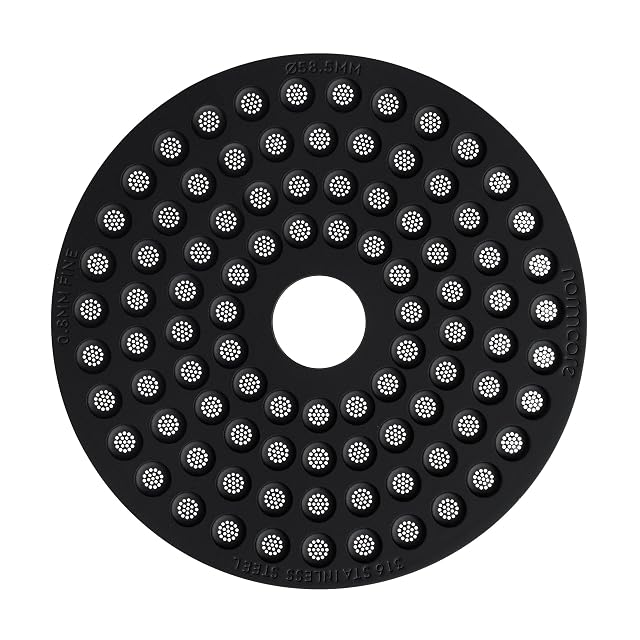
A fine steel disc that sits on the puck. It distributes the incoming water and keeps the shower screen clean — the second of which is the reason to buy it.
Best for: Anyone tired of wiping the shower screen after every session.
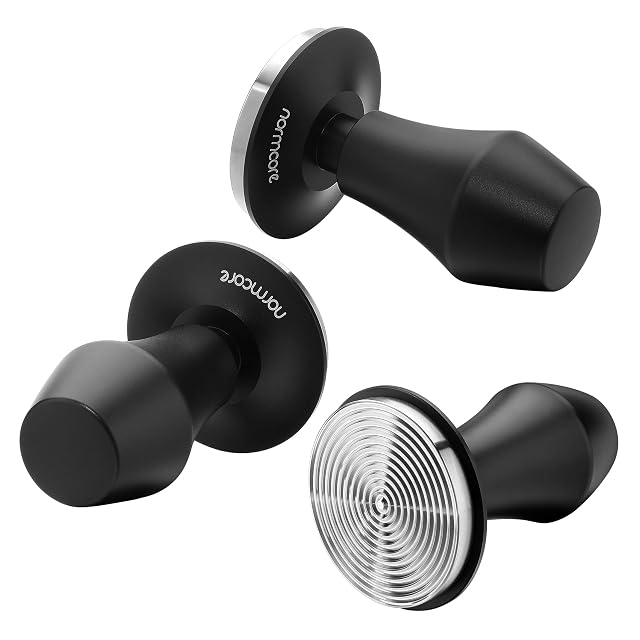
A calibrated spring that clicks at a set pressure, in the 58.5 mm size that actually fills a 58 mm basket. It makes tamping repeatable — which is not the same as making your coffee better.
Best for: Anyone with a 58 mm machine who wants one variable removed from the process.