Skip to content

The best water filters for coffee

Two filters answering two different questions: keeping limescale out of a boiler, and putting the minerals back that extraction actually needs.

Coffee is about 98 per cent water, and that fact is used to sell a great deal of nonsense. Here is the part that is not nonsense: limescale is what kills coffee machines, and it does it silently over years rather than suddenly.

A machine on hard water that is never protected typically starts losing temperature stability and flow somewhere between year three and year five. The same machine on filtered water often passes ten. The intervention costs around thirty a year.

The second question — whether the water makes the coffee taste better rather than just keeping the machine alive — has a different answer and a different cartridge.

Which one do you need?

Your water is very hard
The filter protects the machine first. Taste comes second, and the two answers are not the same.
Your water smells of chlorine
Activated carbon removes most of the taste without touching the mineral content.
You mainly want better coffee
That is not the same as softened water: coffee needs certain minerals to extract properly.
Your machine has its own filter
Start there, and check the machine recognises it: many stay in place long past their useful life.

Choosing by use

Protecting a bean-to-cup

Limescale is the leading cause of failure. Filtering lengthens the interval between descalings without ever removing the need.

Improving the taste

Removing chlorine changes the cup immediately. Adjusting mineral content is a finer exercise, and it assumes you know what you are starting from.

Pour-over and light roasts

This is where water composition shows most. Water too low in minerals gives a flat cup, even with excellent coffee.

Kettles and filter machines

The benefit is mostly taste and cleanliness; these appliances cope with limescale better than an espresso machine does.

The criteria that actually matter

What it removes, and what it leaves
Activated carbon, ion-exchange resin, reverse osmosis: three technologies with very different effects. The first treats taste, the second hardness, the third removes almost everything — including what coffee needs.
How hard your water is to begin with
Without knowing that, no choice can be made. It is on the water bill or on a test strip, and it is the first thing to do.
Compatibility with the machine
Many machines expect a specific cartridge and count litres. A generic filter may work without the machine knowing, which throws its alerts out.
The cost over a year
Cartridges are replaced often. The annual cost frequently exceeds the price of the device, and that is the figure to compare.

Which criterion for which use

Your problemThe answerWhat it will not do
Chlorine tasteActivated carbonReduce hardness
Very hard waterIon-exchange resinRemove the need to descale
Water too softRemineralisingImprove a poor machine
Machine to protectThe maker's own cartridgeReplace maintenance

Mistakes to avoid

Believing a filter replaces descaling
A filter slows scaling, it does not stop it. Machines that admit as much write it into their cycle: the descaling alert returns, later.
Using fully demineralised water
Coffee needs minerals to extract. Pure osmosis water gives a flat, hollow cup, and can cause problems in some machines.
Keeping a cartridge past its life
A saturated cartridge stops filtering and becomes a place where bacteria grow. The life is stated in litres and in weeks, and both count.
Filtering without knowing what you are filtering
Softening already-soft water degrades the coffee. A hardness test costs almost nothing and saves treating a problem you do not have.

Choosing by profile

Hard water and an expensive machine
The maker's cartridge, changed at the stated interval. That is insurance, not comfort.
Decent but chlorinated water
A jug or a carbon filter is enough to transform the cup for very little.
The demanding drinker
Know your water composition, then adjust. It is the last variable left once everything else is in place.

Upkeep and how long it lasts

A water filter is a consumable, and a forgotten consumable becomes a hygiene problem. Saturated carbon releases, exhausted resin does nothing, and water standing in a jug picks up bacteria.

  • Respect the stated life in weeks even if you have filtered little.
  • Rinse a new cartridge as the instructions say before first use.
  • Wash the jug or tank regularly in hot soapy water.
  • Keep filtered water cool and do not keep it for days.

Safety

The subject here is hygiene rather than mechanics.

  • An expired cartridge can become a bacterial reservoir: change it without delay.
  • Do not filter non-potable water: these devices are not purifiers.
  • Avoid leaving filtered water at room temperature all day.
  • Check the device is rated for hot water if you fit it upstream of a machine.
  1. Cheapest way to save a machine Water & descaling

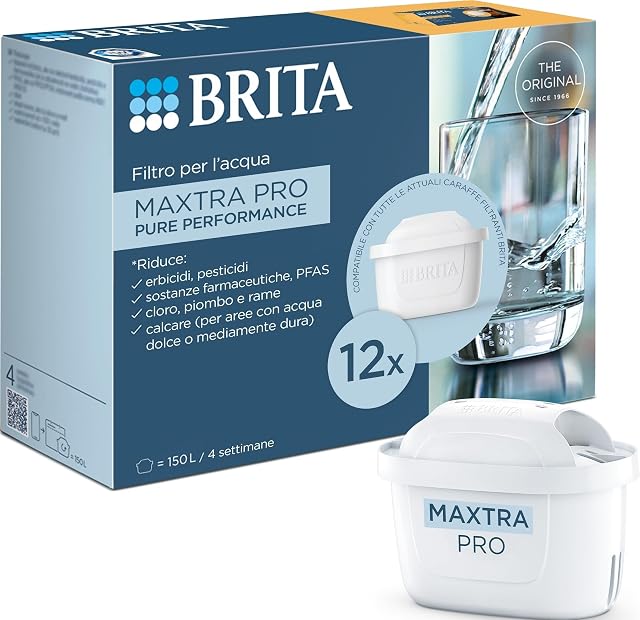
    BRITA Maxtra Pro Pure Performance

    Jug cartridge · reduces carbonate hardness · ≈ 4 weeks

    Not a coffee product, and the highest-return thirty euros in this whole site. Hard water is what kills espresso machines, and a jug filter in front of the tank buys years of life for the price of a few bags of beans.

    Best for: Anyone on water above roughly 150 ppm — which is most of northern Europe.

    7.8/10

    ≈ $40 / £30 / 30 € (12-pack)

  2. Best water for taste Water & descaling

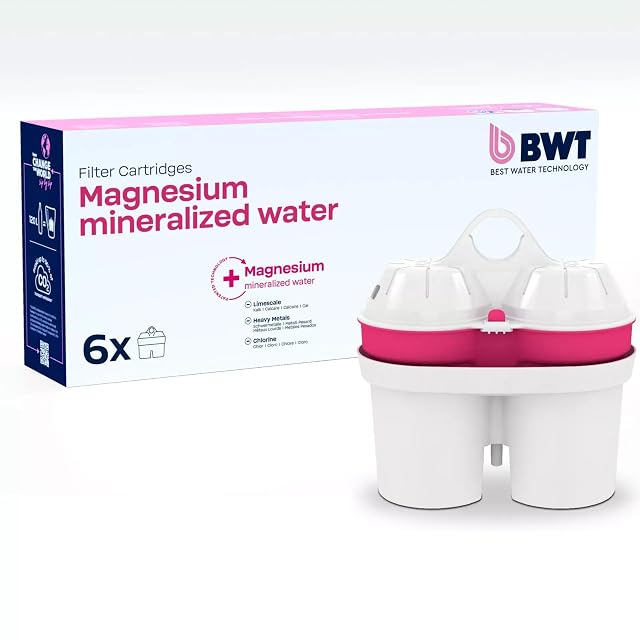
    BWT Magnesium Mineralized Water cartridges

    Jug cartridge · adds magnesium · ≈ 4 weeks

    Unlike a standard filter, this one adds magnesium back after removing hardness. Magnesium is what pulls flavour out of coffee, so the cup gets sweeter rather than just safer for the machine.

    Best for: Someone already filtering who wants the water to improve the coffee, not just protect the machine.

    8.0/10

    ≈ $45 / £35 / 38 € (6-pack)

Questions people actually ask

How do I know if my water needs filtering?

Your water utility publishes hardness by postcode, usually in dH, fH or ppm. Above roughly 150 ppm, limescale is a genuine threat to any machine with a boiler. Below about 50 ppm you have the opposite problem — water that soft extracts poorly and tastes hollow.

Does filtering mean I never descale?

No, and believing that is how filtered machines still die. A filter reduces carbonate hardness substantially but not to zero, so scale still forms, just far more slowly. Descale on the machine schedule; you simply reach it less often.

Why would a filter add minerals back?

Because extraction needs them. Magnesium ions bind to flavour compounds and carry them into solution, so water with some magnesium extracts more sweetness and body. A standard filter strips hardness indiscriminately and leaves water that is safe for the machine and flat in the cup.

Is a filter jug enough?

For removing chlorine and improving taste, yes. To protect a machine in a very hard-water area, the maker's cartridge remains better suited.

Should I filter water for a kettle?

The benefit is mostly taste and cleanliness. A kettle copes with limescale better than an espresso machine, but it still scales.

Is bottled water an answer?

Some low-mineral waters suit coffee well. Cost and waste become the real subject as soon as you use it daily.

How do I find out how hard my water is?

It is on the water bill or on the supplier's website, and a test strip costs a few pounds. It is the first measurement to take before buying anything.

Does a filter really change the taste?

Removing chlorine is audible immediately. Changing mineral content shows mostly on light roasts brewed by hand, where the water becomes an ingredient in its own right.

Why each one, and for whom

BRITA Maxtra Pro Pure Performance · $40

For : Anyone on water above roughly 150 ppm — which is most of northern Europe.

Main strength : Meaningfully reduces the carbonate hardness that forms scale

Main limitation : Reduces scale, does not eliminate it — you still descale, just far less often

Read the full review →

BWT Magnesium Mineralized Water cartridges · $45

For : Someone already filtering who wants the water to improve the coffee, not just protect the machine.

Main strength : Removes carbonate hardness and adds magnesium back — a measurable taste gain

Main limitation : More expensive per cartridge than a plain BRITA

Read the full review →

Deciding in one line

How this guide is built

The models here come from the catalogue of this site. Specifications are those published by the manufacturer and on the Amazon product page; prices are what Keepa reported on the date below, and both move. The ranking uses declared specifications, the balance of stated strengths and limitations, and price. No product on this site has been physically tested, and nothing here claims otherwise.

Last checked on

The tool we use ourselves

Chosen your machine? Now buy it at the right price.

Espresso machines and grinders swing by a hundred euros or more across the year, and the biggest "discounts" often land at prices the same model sold for six weeks earlier. UniverTrack tracks the real price history across retailers, spots fake reductions, and alerts you when it is genuinely the moment to buy.

Real price historyBuy-now alertsAI buying assistant
Try free for 14 days →
No commitment · Cancel in one click · 5 languages