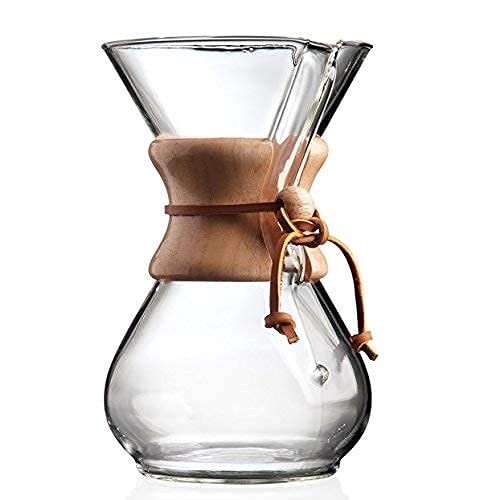
The Chemex has been made essentially unchanged since 1941, and its defining feature is not the shape everyone recognises. It is the paper.
The filter
Chemex bonded filters are 20 to 30 per cent thicker than standard filter papers. That thickness traps the coffee oils that give a cup body, and holds back the fine particles that make a brew taste muddy.
What comes through is remarkably clean — closer to a good tea than to what most people picture as coffee.
What that suits
Light, washed, acidic coffees. A Kenyan or a washed Ethiopian through a Chemex is separated and bright, with a very clean finish.
Not dark roasts. Strip the oils out of a dark Italian roast and you remove what made it worth drinking, leaving something thin.
The method
- 42 g coffee, medium-coarse, for 700 g of water
- Fold the paper so the triple layer sits over the spout channel
- Rinse thoroughly with hot water — the paper is thick and papery — and tip it out
- Bloom with 90 g, wait 45 seconds
- Pour in stages to 700 g, keeping the bed level
- Total 4 to 5 minutes
Practical notes
Grind coarser than for a V60. The commonest complaint about slow Chemex brews is a grind that was fine for a cone.
Buy filters when you buy the brewer. They are proprietary and nothing else substitutes properly. Running out on a Sunday morning is a specific kind of annoyance.
Washing it is awkward. The neck is narrower than an adult hand; a bottle brush is not optional.
Questions people actually ask
Can I use normal filter papers?
Mechanically yes, and it defeats the point. The thickness is what removes the oils and fines that give the Chemex its clarity. A thin paper turns it into a large, slow V60.
Why is mine draining so slowly?
Grind. The thick paper is already restrictive, so a grind that works in a V60 will stall a Chemex. Go a step or two coarser, and make sure the triple-folded side of the paper sits over the pouring channel.