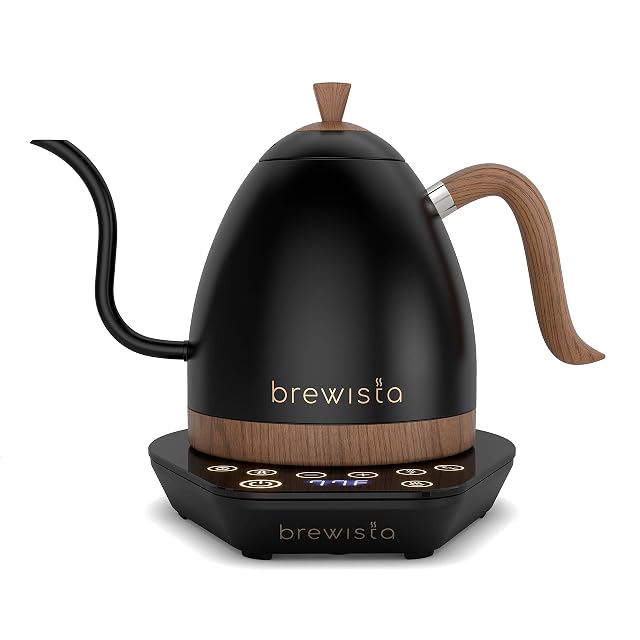
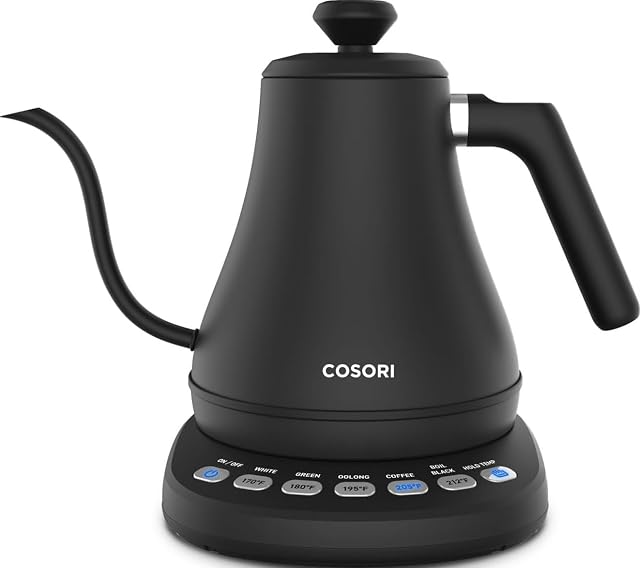
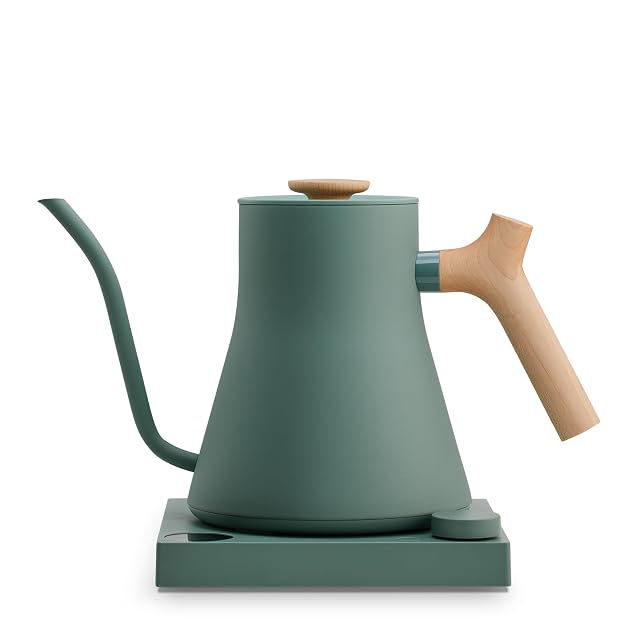
The narrowest spout of any kettle here, which makes very slow pours easier to control than on kettles costing twice as much. The build is lighter, and that is where the money went instead.
The bottom line The best spout under a hundred, in a body that is merely adequate.
Kettle reviews tend to talk about temperature displays because they photograph well. The spout is what changes brews, and this one is the most interesting part of the market under a hundred euros.
The bore is narrower than anything else here, and that narrowness does one specific thing: it makes a very slow stream easy to sustain without it breaking into drips. That is exactly what a bloom needs — forty-five grams of water delivered gently and evenly over a dry bed, with no surges. On faster pours the advantage disappears, because any gooseneck handles those.
Variable temperature and a hold function are both present, and the hold matters more than the setting: the kettle is still at your target when you have finished grinding and rinsing, so brews start identically.
Where the money did not go is the body. It is light — pleasant for long pours, less reassuring as an object — and the base is small enough that a careless reach can knock the kettle off it. Neither a Stagg nor a Brewista feels this insubstantial.
Capacity is the practical limitation. Eight hundred millilitres in a tapered body is one large brew, and the taper means it holds less than the silhouette suggests.
What we like, and what we don't
Strengths
Exceptionally narrow spout — outstanding control at low flow
Variable temperature with hold, at a mid-range price
Light in the hand, which suits long slow pours
Compromises
0.8 L, and the tapered body holds less than it looks
Feels lighter and less solid than a Stagg or an Artisan
Base is small; the kettle can be knocked off it
Where this one sits in its aisle
At 90 £, it is the 3 cheapest of the 5 models in this category published here.
Cheapest in the aisle60 £
Median90 £
Dearest in the aisle195 £
Specifications
Capacity
0.8 L
Temperature
Variable with hold
Spout
Narrow gooseneck
Body
Stainless steel
Base
Wireless
Questions people actually ask
Does a narrower spout actually help?
For the slowest pours, yes. A narrow bore makes it easier to sustain a thin stream without it breaking into drips, which is exactly the control a bloom needs. On faster pours the difference disappears.
Fish Smart or Brewista Artisan?
The Timemore pours slightly better at very low flow and feels lighter; the Brewista is more solidly built and holds a litre. If your brewing is V60 and pour control is the priority, the Timemore. If you want one kettle that also survives being a kettle, the Brewista.
Our score
8.0/ 10
The best spout under a hundred, in a body that is merely adequate.
Who this one is for
Pour-over where the bloom and the first pour need to be very slow.
Compared with its closest rivals
Same category, nearest prices. Only the specifications every one of them states are shown — a half-empty column compares nothing.
Almost everything the Fellow Stagg does, for meaningfully less money and with a litre of capacity instead of 900 ml. It is less beautiful, and that is genuinely the main difference.
Best for: Daily pour-over where the money is better spent on the grinder.
A gooseneck spout and variable temperature for well under half the price of the specialists. The pour is good rather than excellent, and for most people learning pour-over that is enough.
Best for: A first gooseneck, to find out whether pour-over is a habit or a phase.
The best-pouring kettle sold, and the hold function matters more than the thermometer. Expensive for boiling water — but if you brew pour-over daily, it is the accessory that most improves the cup.
Best for: Daily pour-over, where flow rate is the variable you are trying to control.