Alessi asked an engineer, not a stylist, to fix the moka pot. The internal profile interrupts the flow before the bitter steam phase arrives — which is the one thing a classic moka cannot do for you.
The bottom line The moka pot for people who do not watch the hob.
The classic moka pot has one failure mode and it accounts for nearly all bad moka coffee: leaving it on the heat past the point where the water runs out. What comes through after that is steam, and steam extracts nothing but bitterness.
Every guide, including ours, tells you to take the pot off at the first gurgle. The Pulcina’s premise is that people do not, and that this is a design problem rather than a user problem.
The internal profile is shaped so that the flow stops abruptly rather than trailing away. Instead of a long spluttering tail during which the coffee gets progressively worse, the brew simply ends. Brewed carelessly, it makes a distinctly better cup than a Moka Express brewed carelessly.
Brewed attentively, the two are very close, which is the honest way to frame the price. You are paying roughly double for the pot to protect you from a mistake — worthwhile if your mornings are chaotic, less so if you already stand over it.
The rest is Alessi being Alessi: cast aluminium, a shape that is either striking or too much depending on your kitchen, and a spout that genuinely does not dribble. Aluminium means no induction, which rules it out for a growing number of kitchens.
What we like, and what we don't
Strengths
Interrupted flow stops the brew before the bitter phase begins
Genuinely better cup than a classic moka, brewed carelessly
The spout pours without dribbling, which is rarer than it should be
Compromises
Aluminium — not induction compatible
Costs more than twice a Moka Express
Distinctive shape that will not suit every kitchen
Where this one sits in its aisle
At 60 £, it is the 4 cheapest of the 4 models in this category published here.
Cheapest in the aisle35 £
Median60 £
Dearest in the aisle60 £
Specifications
Material
Cast aluminium
Sizes
3 or 6 cups
Induction
No
Feature
Interrupted flow profile
Design
Michele De Lucchi
Questions people actually ask
What does interrupted flow actually do?
The internal geometry causes the coffee to stop rising abruptly once the water in the base runs low, instead of trailing off into a spluttering steam phase. That final steam phase is where most of a moka pot’s bitterness comes from, and this makes it much harder to reach by accident.
Is it worth double a Moka Express?
If you brew attentively — kettle water, low heat, off at the first gurgle — a Moka Express makes coffee just as good and you keep the difference. If you brew while doing three other things, this forgives it, and that is worth paying for.
Our score
8.1/ 10
The moka pot for people who do not watch the hob.
Who this one is for
A moka drinker who will not reliably take the pot off the hob at the right moment.
Compared with its closest rivals
Same category, nearest prices. Only the specifications every one of them states are shown — a half-empty column compares nothing.
If price decides: Bialetti Moka Express 3-cup, at 35 £.
If this one is not the right fit
On a tighter budget: Bialetti Moka Express 3-cup, at 35 £ in the same category. see the review
Price and availability
A reference exists on these Amazon stores: Germany, Spain, United Kingdom, United States. Listed is not the same as in stock — availability changes daily.
Details checked on August 8, 2026.
Sources
Specifications: manufacturer sheet and Amazon product page. Prices and availability: Keepa. No product on this site has been physically tested.
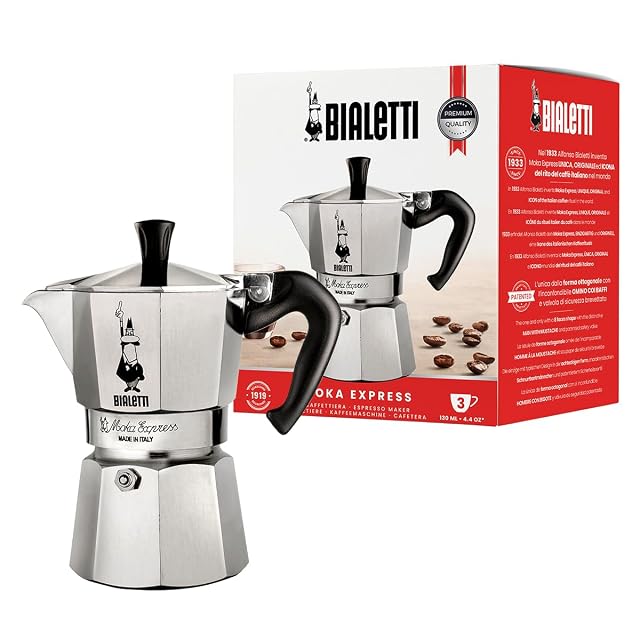
Ninety years old, sold by the million, and misused by almost everyone who owns one. Brewed properly — low heat, pre-boiled water, off the hob at the first gurgle — it is one of the great cheap coffees.
Best for: One or two strong cups on a gas or electric hob, at almost no cost.
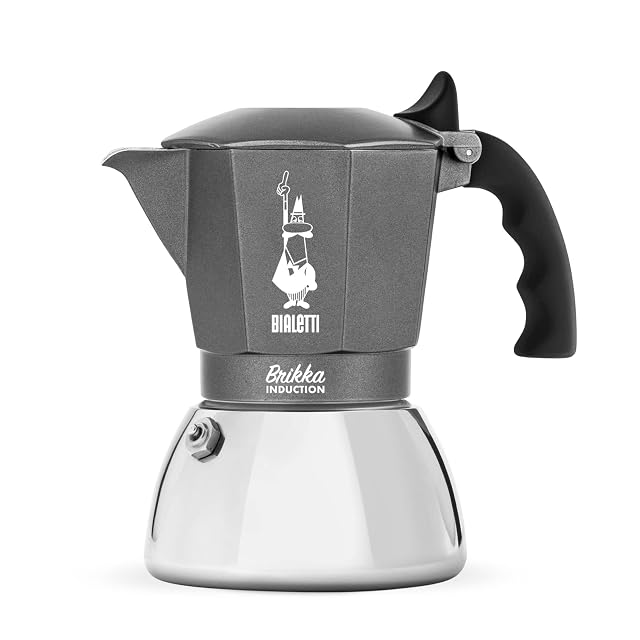
A weighted valve holds pressure back until it releases in one burst, which produces a genuine layer of crema. It is also fussier than a normal moka, and unforgiving if you fill it wrong.
Best for: A moka drinker who wants something closer to espresso and will follow the instructions.
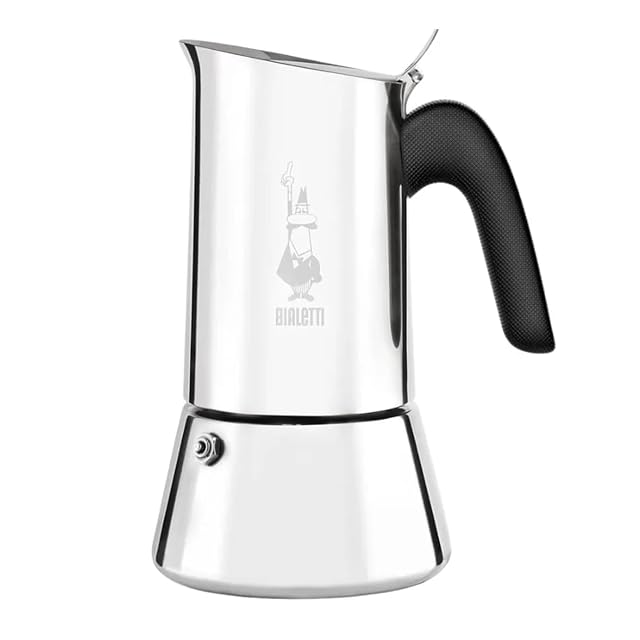
The stainless Bialetti that works on induction, which the aluminium Moka Express does not. Slower to heat, easier to clean, and it will outlive the classic.
Best for: Anyone with an induction hob, or who wants a moka pot that goes in the dishwasher.